Thursday, June 30, 2011


In a group show that opened on Friday, the David B Smith Gallery in Denver brought together five artists with differing mediums that shared a unitive theme of exploring the human relationship with nature in one way or another. From large installations that cover numerous city blocks to images made from scotch tape on chalkboards, the varying work peered into the changing face of the natural world resulting from human impact. “All of the artists that are here relate their work back to nature, consumption, and the way that we as humans inhabit the earth and use resources,” said gallery owner David Smith.

Read the rest of my review and see photos of the art here.

Saturday, June 4, 2011


I recently had the pleasure of interviewing one of my favorite artists,
Nathan Spoor, for one of my favorite publications, Juxtapoz. Spoor just opened his first solo show in two years, aptly named The Phantom Passport. The show runs through June 4th at Bold Hype in New York, where his paintings buzz with activity, detail and color, while maintaining a placid stillness amidst the chaos. I caught up with Spoor to ask him a few questions about his work- read the interview here.


I also attended an opening of Los Angeles-based artist Kris Lewis' work at the David B. Smith Gallery in Denver. Lewis masterfully blends traditional portraiture with a stylized modern edge, resulting in emotion laden subjects brimming with mystery and depth. I interviewed him for another publication I love, Hi-Fructose Magazine. Read it here.

Friday, May 6, 2011

Reflections

sunset off the coast of the Dominican Republic

Last year at this time, I had just returned home from sailing the Caribbean on the Research Vessel Heraclitus and wandering 'round Guatemala for a few weeks. I started off that trip with hopes of finding direction, yet as often happens, my expectations were unfulfilled and I was met with the exact opposite of what I had planned. Rather than returning home steady, motivated, and fired up with purpose, I collapsed onto my couch, horrendously ill, with my ego even more shaky than when I had set out.

the shores of Lake Atitlan in Guatemala

Looking back at that tumultuous time, I'm immensely grateful for the collapse of my rigidly constructed paradigm. The rubble of my old self made room for new experiences and a more authentic version of me to emerge from the ruins. The phenomenon of "failure" and struggle bringing immense gifts is something that I have experienced so much that I've become more able to appreciate it in the moment, rather than only being able to see the benefits with the clarity of hindsight.

Speaking of hindsight and failure and all that- I guess I should rewind a bit to cover my last trip to Vegas. After all that talk in my previous post about 'High Flames Drifter,' I decided not to go to the Virgin River Gorge to try it again (at least not until the cliff is in season again).

Until we meet again High Flames... (Andy Mann photo)

This was a hard decision to make, but while I was camping and climbing amid the deserted quiet of the Cathedral in Utah, I decided that I didn't miss the roaring highway noise of the VRG and that I should spend my ten day trip trying some new routes.

lovely desert desolation

As much as I wanted to send High Flames, I'm really happy I decided to stay at the Cathedral instead. The atmosphere there is in many ways idyllic- quiet, lonely desert views with cliff swallows and kestrels swooping down through the dry breeze. Not to mention amazing climbing.

My good friend Katy Dannenberg climbing at the Wailing Wall


Not obsessing over sending High Flames also allowed me the time to climb a multi-pitch in Red Rocks, something I've wanted to do again ever since climbing the ultra-fun, classic 'Prince of Darkness' last year. Superhero climber Jonathan Siegrist and I decided to try 'Rock Warrior' a 5.10 R/X on the Black Velvet Wall, just next to 'Prince of Darkness.'

a stormy day at the Black Velvet Wall

Before I even left the ground, I was stressed and adrenalized from belaying Jonathan on the first pitch. He unknowingly started at the wrong place, putting himself on an incredibly run out 5.11 slabby pitch of sloper crimps and smeary little feet. The remaining five pitches also were almost as run out as the first, making me very happy that I was leaving the leading to a pro.

Red Rocks beauty

We also spent a day climbing at Arrow Canyon, a really unique little crag that you reach by hiking through a beautiful limestone slot canyon, complete with petroglyphs.

'Tangled Up in Blue,' 12a, at Arrow Canyon

Since then, I've been back in Boulder packing up my life in preparation for my move to San Francisco in the fall to attend grad school. I've finally found that sense of purpose I was so desperate for last spring, but it only came after I surrendered to the unfolding process of decay and regeneration.

As one of my favorite Buddhist teachers, Reginald Ray, says, "You can either strive to be perfect or you can strive to be whole. If you strive to be whole, you have to surrender to your process. You have to surrender to the seasons of your own psyche, of your own internal working. You have to give yourself room to be in darkness, to be depressed. You have to give yourself room to be tired. You have to give yourself room to be completely uninspired. And you have to realize that allowing yourself to be depressed, tired and totally uninspired is the ultimate trust in the universe."


Friend of Salvador Dalí, former apprentice of Ernst Fuchs, and husband of artist Martina Hoffman, Boulder painter Robert Venosa has lived his life in the sort of rich artistic atmosphere that few ever experience. As he says on his website, "At various times I had Jimi Hendrix, Miles Davis, Jackie Kennedy and the good doctor Timothy Leary himself peering over my shoulder to see what I was up to.”

Read my article on Venosa's life and work here.

Wednesday, April 6, 2011


the view of Red Rocks from Turtlehead Mountain just outside of Las Vegas

Lately I've noticed an interesting correlation. It seems to me that the more profound of an experience I have while climbing, the more cliche and trite it sounds when I try to share it with others. I think that this can often be the case when we try to relate personal experiences that have effected us in subtle yet powerful ways. When we try to put words to aspects of life that are outside of the logical and verbal realms of our mind, so much is lost in translation. So although I realize that many of the breakthroughs and reflections that I've gained through climbing will remain fully understood only by me (and even that isn't guaranteed!), I'm still going to continue trying to communicate at least some small part of why climbing is such a potent force in my life.

So here I go.

We're all familiar with the idea that our moments of greatest growth occur when we don't get what we want. It's something everybody has heard from a well-intentioned friend in a disgruntled moment, usually when it's the last thing we want to hear. Then later, after hours or days or weeks have passed, we can see that in truth the undesirable circumstance really did force us to push against the boundaries of our hopes and fears, desires and aversions. In a nutshell, that's what I experienced climbing at the infamous Virgin River Gorge during a month-long stay in Las Vegas.

Jonathan Siegrist crushing at the VRG

Located near the borders of Arizona, Utah, and Nevada, the VRG is known to be one of the highest quality, most difficult crags in the country. Overlooking the roaring lanes of traffic on interstate highway I-15, the limestone cliffs offer a variety of brilliant, difficult climbing.

It didn't take long for the VRG to stir up some really unpleasant emotions in me. It first began when I looked around me and noticed that everyone at the crag was strong enough to warm up on whatever I would end up projecting. Having learned to climb around superhuman climbers, this is something I should be used to, but my ego just hates being the worst at anything. Regardless, I decided to try High Flames Drifter, a 12c that everyone agreed was difficult for the grade. If I were to succeed, it would be my one of my most difficult climbs to date.

me on High Flames

After days of one-hanging the route, I felt entirely confident that I would redpoint on my next try. I climbed through the crux feeling poised and strong, with only a clip and then one more hard move and remaining between me and success. But when I went to clip, due to some minor shift in my body position, the rope got caught behind my leg (this can be very dangerous because it can cause you to flip upside down and hit your head on the wall). Being so close to success, I fought to get the rope out from behind my leg so that I could make the clip. My arms quickly grew tired from grasping such small holds. My grip weakened, my fingers slipped, and then I was upside down, falling through the air, colliding with the wall. Luckily I had a very experienced belayer who helped keep me from hitting my head, and I escaped with some bruises and cuts, and a rope burn on my leg that is now a purplish scar.

After taking this pretty scary fall, I just couldn't get my head right. With the knowledge that I was leaving the area in a few days, I tried the route a handful of other times, but it was always with a sense of dread and trepidation. Before getting on the route for the last time, I had a mini-emotional breakdown, crying because I knew that I didn't have what it would take at that moment to send.

Andy Mann photo

Somehow, failure in climbing touches the most vulnerable and insecure part of me, a place that nothing else can reach. In that moment of accepting failure, I felt such a wrenching sense of disappointment and defeat. My deepest feelings of self-doubt were activated and my most painful wounds of feeling worthless or unworthy were probed. It was shocking to look into myself and see such feelings that I usually keep successfully buried.


I'm going back to try the route again in a few days, with hopes of being able to successfully clip the chains this time. Whether or not that happens, this route has affected me in a way that goes beyond the physical act of climbing. Through failing, I was able to break through innumerable layers of walls and boundaries that I usually keep between my awareness and those deeply buried feelings. I was able to see a part of myself that I didn't know existed, a part that needs to be acknowledged so that it can heal. In the end, I'm glad I took that upside down fall instead of sending like I'd hoped. Failing gifted me the opportunity to know myself in a more holistic way than I previously had.

While I love the social and fun aspects of climbing, it's experiences like this one that have ignited a passion and commitment to the sport in me. Climbing provides a painfully clear mirror in which I can see myself reflected, allowing me to learn and grow. And that's what it's all about in the end.


Friday, March 18, 2011

Warhol in Colorado

Born in 1928 in Pittsburgh as the third child of immigrant parents, Andy Warhol suffered through his childhood as an outcast and a hypochondriac. It seemed unlikely then that this often bed-ridden child would one day rise to fame as one of the leading figures of the pop art movement.

With his portrayal of mass-produced products, mundane objects and celebrities from American popular culture, Warhol achieved massive success as a painter, sculptor and prolific filmmaker. In 1963, his piece “Eight Elvises” sold for $100 million, a feat achieved by only a handful of other artists, including Vincent van Gogh, Pablo Picasso and Jackson Pollock.

Warhol survived a gunshot wound from a dramatic attempted murder in 1968, only to die from a routine gallbladder surgery in 1987. In his will, he bequeathed almost his entire estate to creating a foundation dedicated to the advancement of visual art. The result was The Andy Warhol Foundation for the Visual Arts, which focuses primarily on supporting artistic work of a challenging and often experimental nature.

In 2008, The Foundation gave 156 of Warhol’s photographs to the University of Colorado’s Art Museum. The museum premiered 112 of the pieces on Jan. 21 and will continue showing them until June 25.

To read the rest of my article, click here.


Saturday, March 5, 2011

Internationally recognized Brazilian artist Henrique Oliveira created a site specific installation piece at the Boulder Museum of Contemporary Art that will be on display until mid June.

Oliveira works primarily with reused strips of pliable fencing wood that commonly surround construction sites in his hometown of São Paulo. He often uses this medium to explore the texture of thick gestural brushstrokes that one would find in an oil painting. Oliveira compares this concept to taking a small corner of a densely textured painting and enlarging it to the size of a wall, allowing the viewer to see the subtle details of a brushstroke.

Read my review of the show here.

Friday, February 4, 2011

Ice climbing in Ouray, Colorado


Ouray, Colorado is one of the most popular ice climbing destinations in the world. The town's canyons boast over a mile of ice jaggedly draped over its cliff faces, the majority of which is "farmed" ice. Metal piping runs over the tops of these canyons, allowing the town to turn the water on every few nights. The water runs down the cliffs and freezes into thick sheets of ice in some places and beautiful yet slightly terrifying icicles in others.

I've managed to be a climber for three years and avoid ice climbing all the while, but last weekend I finally caved and gave it a try. I was incredibly pleasantly surprised.


Turns out, ice climbing is neither as cold, miserable, scary, or difficult as I had imagined. Sure, there were times during the weekend that I could use any and all of those adjectives to describe my experience, but for the most part, I was only partially freezing and mostly enjoying myself.


I felt very fortunate to have a very experienced and patient friend introduce me to the sport. Knowing that I'm safe makes all the difference for me in being able to push myself physically and mentally at a new and potentially dangerous sport.


The group I was with rented out the entire Historic Western Hotel, which has been open since the 1890's. The ambiance was musty and the decor was an antiquated mix between Victorian and rustic. The creaking floor boards rose and feel like waves, the hallways were narrow and uninviting, and everywhere the eyes of people in old photos followed you as you walked by. It was equal parts creepy and fascinating.


Here's just a tiny portion of the hotel's vast collection of eerie, dusty animal pelts and heads.

I finished the weekend by following my friend up an 150 foot climb called "Tangled Up in Blue." The satisfying sensation of puncturing the ice with an ice ax in just the right way so that it goes in deeply and securely enough that you can pull your whole body weight up by it was addicting. Imagine stabbing thick styrofoam with a butter knife, now imagine the same sensation but many, many more times the physical effort. Fun.

I particularly enjoyed the crumbling blocks of ice that fell down on my head with every other whack of the ax, even though that cost me a bleeding lip and a bruised nose. More than anything, I appreciated finding yet another excuse to get out into a remote, pristine location and bond with good people while reveling in nature's beauty. That to me is really the heart of climbing, whether rock or ice.


Thursday, December 23, 2010


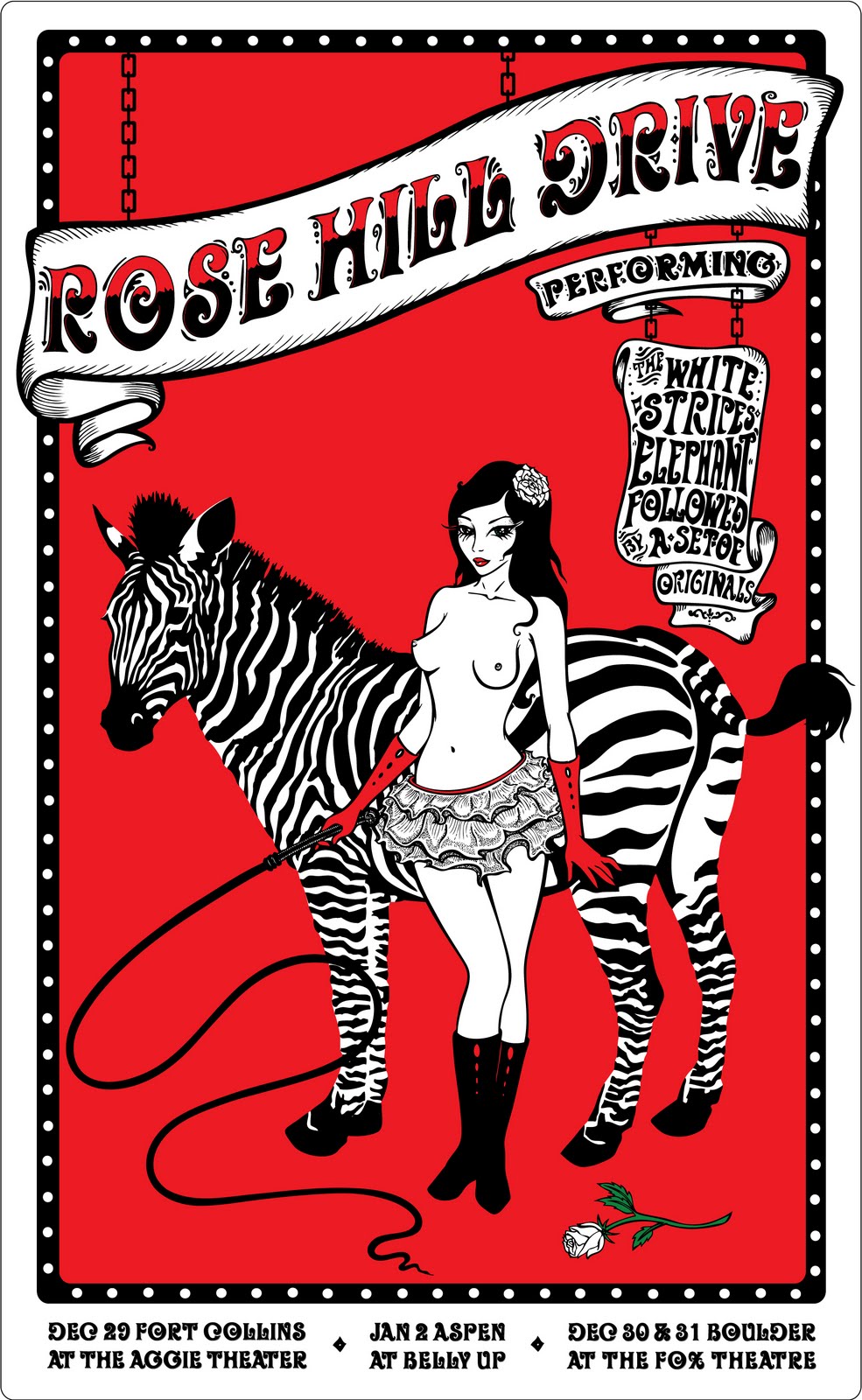
Here's my most recent commission- a concert poster for Boulder-based rock 'n' roll band Rose Hill Drive's New Years shows. Since they'll be covering the White Stripes, I figured I would throw in a zebra for good measure.

Click on it to view a larger version.

Based out of San Francisco, Juxtapoz magazine is without question my paramount source for inspiration and education about what's happening in the ever-evolving world of low-brow or pop surrealist art. For this reason, I was incredibly excited to write a review for them of the super talented mixed media artist Robert Hardgrave's show "Relic," which recently opened in Denver at the David B. Smith gallery. I even managed to sneak into some of the photos. Read it and view it here!

"Born and raised in the suburbs of Los Angeles, Boulder artist Jason García’s paintings still carry with them the edge and ferocity of the city. An accomplished artist on various fronts, García’s art has manifested everywhere from murals on city streets to fine art pieces hanging in downtown galleries. He can also take credit for being one of the founding pioneers of live painting, having toured with Sound Tribe Sector Nine for nearly a decade.

While these days it’s a common sight to see an artist onstage with a band, back when García started, the concept was virgin and unexplored. When he was first approached by a San Francisco band in 1998 to paint onstage, he had never heard of anyone doing such a thing."


Read the rest of my article on artist Jason García here.

Thursday, December 9, 2010


My most recent article on rock 'n' roll photographer Lisa Siciliano- read it
here.

Monday, November 29, 2010


Seven years ago, in a small tent in the midst of a snowstorm in the Himalayas, climber and photographer Jonny Copp drafted the idea for the Adventure Film Festival on a handful of scratch paper. Since then, the idea has grown into an itnernational festival of independent films addressing everything from environmental activism to extreme sports.

“Adventure films are fun, both to watch and to make,” said photographer Vance Howard. “I think of it as being similar to our ancestral elders returning to the campfire from an ancient hunt for game and sharing stories of the journey. It’s the same idea now, only we have the glow of HDTVs replacing the sparks and embers of the campfire.”

Read the rest of my article on the Adventure Film Festival here.

For those of you aren't familiar with Boulder artist Bryce Widom, I highly recommend that you acquaint yourself with his work. Here's a review I wrote of his joint show with Colorado painter Tammi Otis at SmithKlein Gallery in Boulder.

Monday, November 8, 2010

Yoko Ono called me last week.

During a 15 minute interview about a touring show of John Lennon's artwork which was in Boulder for the weekend, Yoko and I talked about John's work as an artist and a musician, why his artwork wasn't taken seriously while he was alive, and the criticism she has received for adding color to some prints of his work.

Read the interview here and the corresponding story on the show here.

Thursday, November 4, 2010

Elephant Journal just published a short review I wrote of Buddhist teacher Andrew Holecek's most recent book, The Power and the Pain: Transforming Spiritual Hardship into Joy.

"As Holocek, a committed veteran of the Buddhist path, writes, “waking up hurts.” Yet it is during those times of collapse and crisis that we are presented with potent potential for transformation and realization."

Read the rest here.

Friday, October 29, 2010

"Being comfortable has never been one of the selling points of rock climbing. Between the ever-present ache of tight shoes, the exposure to the elements and the occasional torn and bloody fingertip, climbers are used to enduring a fair amount of suffering in pursuit of their passion. However, once that autumn chill touches the air and the snowflakes start to fall, even some of the most stalwart enthusiasts head to the gym rather than subject themselves to belaying in the cold."

Click here to read the rest of the article I wrote on the best places to climb in the winter in Colorado.

Friday, October 22, 2010

Tattoo Time

About a month ago, as the end of September approached, I journeyed into Rising Tide Tattoo to get my most recent tattoo finished. During the year that had passed since I got the first part completed, my perception of my tattoo and my relationship to it has changed dramatically. I must admit that at first it was pretty startling to see the swirling designs of ink on my forearm every time I looked down, and the shock of making such a large and permanent change to my body definitely rattled my equilibrium. It seemed that the physical act of getting tattooed had ramifications that rippled through other seemingly unrelated areas of my life. Only hours after that first tattooing session, I experienced a profound and terrifying paradigm shift that ripped away many of the comfortable shrouds that I had erected between myself and ultimate reality. Although painful and scary at first, this shift proved to be the beginning of one of the most intense phases of growth I’ve experienced in my life thus far. Somehow, the simple physical act of being tattooed acted as a catalyst for this change.


When I returned to get my tattoo finished, I brought this phenomena up with Phil, the tattoo artist at Rising Tide. He said that he commonly hears similar stories of huge shifts in people’s lives and mentalities after being tattooed. I had begun to describe what I experienced in my life after being tattooed as feeling like some sort of initiation or rite of passage. Hearing that other people experienced a similar sensation made me curious about the role of tattooing through human history, and it’s seemingly latent potential for unlocking spiritual growth.


Many ancient cultures, such as the Egyptians, Persians, and Chinese, engaged in tattooing for spiritual purposes. Evidence of tattooing has been found as early as the Neolithic times- instruments that were most likely used for tattooing have been discovered at several archeological sites in Europe that were made from sharp bone needles and red ochre, which was used as the pigment to dye the skin. Ötzi the Iceman, a natural mummy dating from the fourth to fifth millennium BC who was preserved in a glacier in the Ötz valley in the Alps, had approximately 57 carbon tattoos consisting of simple dots and lines on his lower spine, behind his left knee, and on his right ankle. These tattoos were thought to be healing related because their placements correspond with acupuncture points.


Another well-preserved mummy, The Man of Pazyryk, a Scythian chieftain, has detailed tattoos of fish, monsters, dots and lines that are over 2,500 years old (shown below).


Many indigenous cultures throughout time and across the world have recognized the spiritual import of tattooing, and although I still don’t understand exactly how a simple physical act crosses over into the spiritual realm in such a profound way, my own experience states that it certainly does.

The significance of my tattoo, the flower Datura Solanaceae, also known as Moonflower or Jimson Weed, is multifarious. Regarded as a sacred plant by indigenous cultures in widespread places including North America, Central America, South America and Asia, Datura is a ceremonial, medicinal, and psychedelic flower that is as powerful as it is beautiful. Often associated with a dark feminine spirit, each Datura flower blooms once in the evening, releasing a potent citrus scent that is said to affect one’s dreams if inhaled before sleep. The famous American artist Georgia O’Keefe, one of my role models, paid homage to this plant in many of her paintings.


I grew up with Datura blooming in my yard, teaching me about the secret life of plants and imprinting it’s translucent and eerie beauty onto my psyche. The journey of turning that mental imprint into a physical one has been a shockingly transformative experience. I hope you enjoy the short video I put together to share the adventure!


Tattoo Time from Marisa Aragon Ware on Vimeo.